

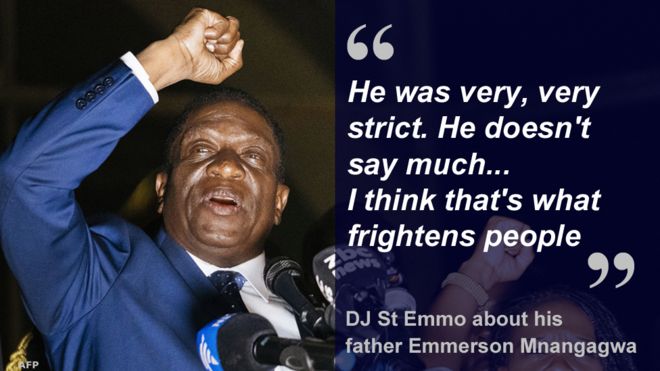
Mr Mugabe, 93, resigned amid a military takeover and mass demonstrations - all sparked by his sacking of Mr Mnangagwa as his vice-president.
"The crocodile", who lived up to his name and snapped back, may have unseated Zimbabwe's only ruler, but he is still associated with some of worst atrocities committed under the ruling Zanu-PF party since independence in 1980.
One veteran of the liberation struggle, who worked with him for many years, once put it simply: "He's a very cruel man, very cruel."
But his children see him as a principled, if unemotional, man. His daughter, Farai Mlotshwa - a property developer and the eldest of his nine children by two
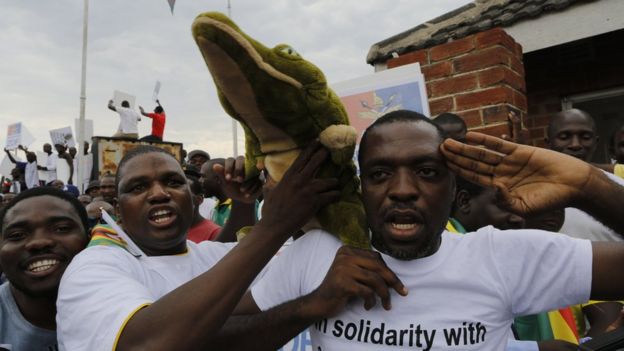
As if to reinforce this softer image of the new leader, a cuddly crocodile soft toy was being passed among the Zanu-PF supporters welcoming him back to the country after Mr Mugabe's resignation.
"Mnangagwa is a practical person. He is a person who recognises that politics is politics but people must eat. Adding that reforming Zimbabwe's disastrous economy will be the focus of his leadership.
Who is Emmerson Mnangagwa?
Known as "the crocodile" because of his political shrewdness - his Zanu-PF faction is "Lacoste"
Received military training in China and Egypt
Tortured by Rhodesian forces after his "crocodile gang" staged attacks
Helped direct Zimbabwe's war of independence in the 1960s and 1970s
Became the country's spymaster during the 1980s civil conflict, in which thousands of civilians were killed, but has denied any role in the massacres, blaming the army
Accused of masterminding attacks on opposition supporters after 2008 election
Says he will deliver jobs, and seen as open to economic reforms
The exact year of Mr Mnangagwa's birth is not known - but he is thought to be 75, so nearly 20 years younger than his predecessor.
Born in the central region of Zvishavane, he is a Karanga - the largest clan of Zimbabwe's majority Shona community.
Some Karangas feel it is their turn for power, following 37 years of domination by Mr Mugabe's Zezuru clan, though he himself has been accused of profiting during his time in power.
According to a United Nations report in 2001, Mr Mnangagwa was seen as "the architect of the commercial activities of Zanu-PF".
This largely related to the operations of the Zimbabwean army and businessmen in the Democratic Republic of Congo.
Zimbabwean troops intervened in the DR Congo conflict on the side of the government and, like those of other countries, were accused of using the conflict to loot some of its rich natural resources such as diamonds, gold and other minerals.
'Blood on his hands'
Despite his money-raising role, Mr Mnangagwa, a lawyer who grew up in Zambia, was not always well-loved by the rank and file of his own party.
A Zanu-PF official posed an interesting question when asked about Mr Mnangagwa's prospects: "You think Mugabe is bad, but have you thought that whoever comes after him could be even worse?"
The opposition candidate who defeated Mr Mnangagwa in the 2000 parliamentary campaign in Kwekwe Central, Blessing Chebundo, might agree.
During a bitter campaign, Mr Chebundo escaped death by a whisker when the Zanu-PF youths who had abducted him and doused him with petrol were unable to light a match.
Mr Mnangagwa's fearsome reputation was made during the civil war which broke out in the 1980s between Mr Mugabe's Zanu party and the Zapu party of Joshua Nkomo.
As national security minister, he was in charge of the Central Intelligence Organisation (CIO), which worked hand in glove with the army to suppress Zapu.
Thousands of innocent civilians - mainly ethnic Ndebeles, seen as Zapu supporters - were killed in a campaign known as Gukurahundi, before the two parties merged to form Zanu-PF.
Among countless other atrocities carried out by North Korean-trained Fifth Brigade of the army, villagers were forced at gunpoint to dance on the freshly dug graves of their relatives and chant pro-Mugabe slogans.
Mr Mnangagwa has denied any role in the massacres, but the wounds are still painful and many party officials, not to mention voters, in Matabeleland will find a Mnangagwa presidency unpalatable.
He does enjoy the support of many of the war veterans who led the campaign of violence against the white farmers and the opposition from 2000.
They remember him as one of the men who, following his military training in China and Egypt, directed the fight for independence in the 1960s and 1970s.
He also attended the Beijing School of Ideology, run by the Chinese Communist Party.

No comments: