

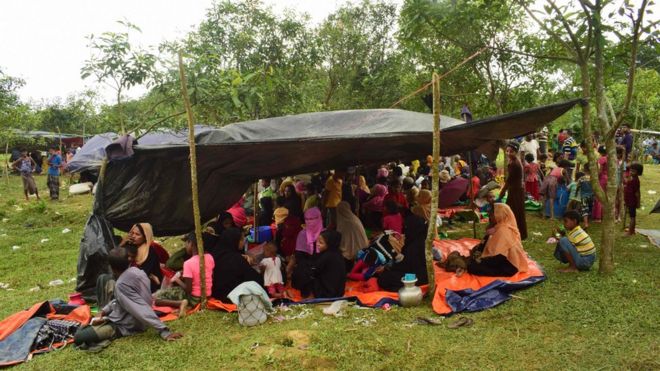
The crisis erupted after Rohingya insurgents attacked 30 police stations last Friday, triggering a military response.
Thousands more are waiting at the border, local sources say.
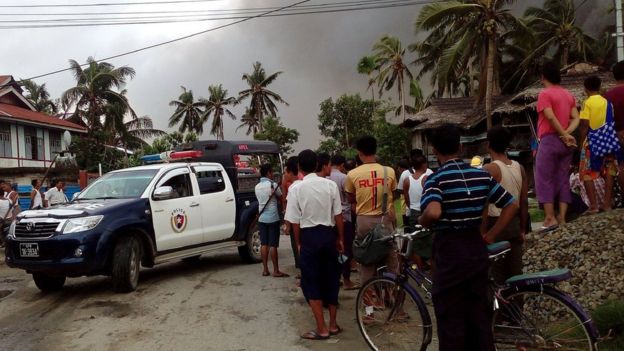
At least 100 people, mostly insurgents, have been reported killed in the latest violence in Rakhine. Independent confirmation from the state is almost impossible as few journalists are given access.
What's the situation at the border?
The International Organisation for Migration said on Wednesday that about 18,500 Rohingya - mostly women and children - had crossed into Bangladesh since last Friday's attacks.
Peppi Siddiq, a spokesperson for the IOM, told the BBC: "There are still thousands of people in no-man's land and we have no access to that area.
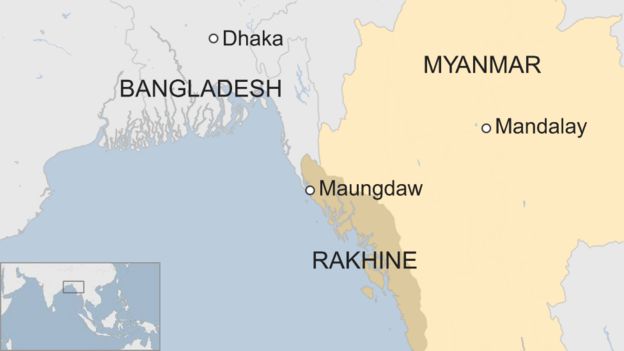
More than 100,000 Rohingya refugees have now entered Bangladesh since last October, accusing the Myanmar authorities of ethnic persecution.
- What sparked latest violence in Rakhine?
- Annan warns on Rakhine 'radicalisation'
- Who will help Myanmar's Rohingya?
- Truth, lies and Aung San Suu Kyi
The authorities in Bangladesh have been turning many Rohingyas from Myanmar back - both countries say the Rohingya are not their citizens.
"The situation is very terrifying, houses are burning, all the people ran away from their homes, parents and children were divided, some were lost, some are dead," Abdullah, a young Rohingya man who had made it to Bangladesh, told Reuters.
How bad is the crisis?
Aid workers say this latest tidal wave of refugees is so intense that their only focus at the moment is the immediate task of saving lives. They haven't yet had time to interview the new arrivals and hear their stories.
Some women have given birth in the camps. Some manage to carry possessions - clothes or even cooking utensils - but most arrive with nothing.
Crossing the border is hazardous. In places, it runs alongside a road where Bangladeshi border guards routinely patrol, enforcing the government's official policy of refusing entry. But many refugees make it across elsewhere, often through dense jungle.
Myanmar accuses Bangladesh of harbouring Rohingya militants whom it views as Bengalis. Bangladesh denies this - and seems keen to show its determination to address terrorism in all forms.
This week, it apparently suggested joint border patrols but there's no sign of that offer being accepted.
In the meantime, the violence in Rakhine state and the flood of refugees continue - leading aid workers to call this one of the world's forgotten crises.
Who are the militants?
A group called the Arakan Rohingya Salvation Army (Arsa) says it carried out Friday's attacks. The group first emerged in October 2016, when it carried out similar assaults on police posts, killing nine police officers.
It says its primary aim is to protect the Rohingya Muslim minority from state repression in Myanmar.
The government says Arsa is a terrorist group whose leaders have been trained abroad. Its leader is Ata Ullah, a Rohingya born in Pakistan who was raised in Saudi Arabia, according to the International Crisis Group.
But a spokesman for the group told Asia Times that it had no links to jihadi groups and that its members were young Rohingya men angered by events since communal violence in 2012.
What is life like for Rohingya?
Rakhine, the poorest region in Myanmar (also called Burma), is home to more than a million Rohingya.
They face severe restrictions inside mainly Buddhist Myanmar, where tensions with the majority population have been rumbling for years.
This is the most significant outbreak of violence in Rakhine since October 2016, when nine policemen died in similar attacks on border posts. The government said they were carried out by a previously unknown Rohingya militant group.
The attacks triggered a military crackdown that led to widespread allegations of killings, rape and torture of Rohingya, and an exodus of Rohingya into Bangladesh.



No comments: