

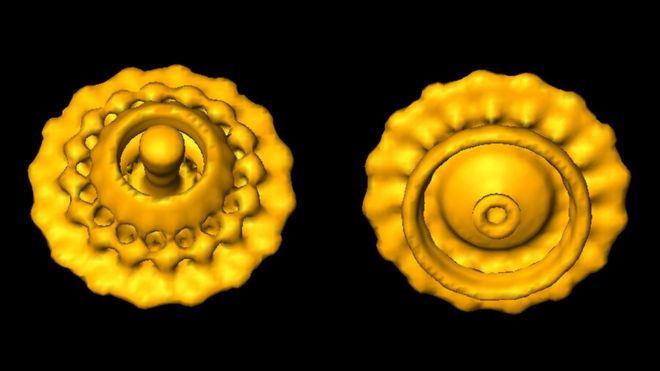
They developed a technique called cryo-electron microscopy, which simplifies the process for looking at the building blocks of biology.
The winners join a prestigious list of 175 other Chemistry laureates recognised since 1901.
They were named at a press conference in Sweden.
The process makes it possible for biomolecules to be frozen very fast, allowing their natural shape to be preserved.
http://www.fow24news.com/2017/10/breaking-news-nobel-prize-awarded-for.html
Speaking to journalists over a telephone line, Prof Frank said the practical uses for the technique were "immense".
Joachim Frank, from Germany, made the technology more easy to apply in a general setting by processing images of the molecules in such a way that fuzzy two-dimensional images were turned into sharp, 3-D structures.
Swiss-born Jacques Dubochet managed to cool water so rapidly that it solidified around a biological sample.
Scot Richard Henderson then succeeded in presenting the structure of a bacterial molecule at atomic resolution.
Previous winners of the Nobel Prize in Chemistry
2016 - Jean-Pierre Sauvage, Fraser Stoddart and Bernard Feringa shared the prize for the making machines on a molecular scale.

2014 - Eric Betzig, Stefan Hell and William Moerner were awarded the prize for improving the resolution of optical microscopes.
2013 - Michael Levitt, Martin Karplus and Arieh Warshel shared the prize, for devising computer simulations of chemical processes.
2012 - Work that revealed how protein receptors pass signals between living cells and the environment won the prize for Robert Lefkowitz and Brian Kobilka.
2011 - Dan Schechtman received the prize for discovering the "impossible" structure of quasicrystals.
2010 - Richard Heck, Ei-ichi Negishi and Akira Suzuki were recognised for developing new ways of linking carbon atoms together.

No comments: