

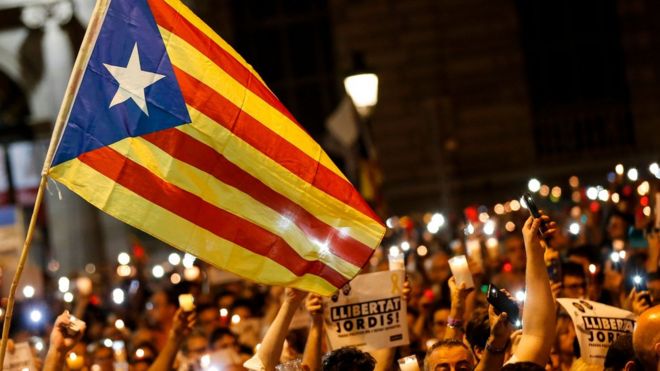
The meeting comes almost three weeks after the region held a controversial independence referendum, which was ruled illegal by the supreme court.
Catalan leader Carles Puigdemont argues that the referendum result gave him a mandate to pursue independence.
But Spain's government disagrees and is preparing to take back power.
How did we get here?
Catalonia's regional government held a referendum on 1 October to ask residents of the region if they wanted to break away from Spain.
Of the 43% of Catalans said to have taken part, 90% voted in favour of independence. But many anti-independence supporters boycotted the ballot, arguing it was not valid.
Reality Check: Would Catalonia be a viable country?
Cases for and against independence
The crisis in 300 words
Mr Puigdemont and other regional leaders then signed a declaration of independence, but immediately suspended it in order to allow for talks.
He then defied two deadlines set by the national government to clarify Catalonia's position, and the government announced it would pursue Article 155.
What is Article 155?
Article 155 of the Spanish constitution allows the national government to impose direct rule over Spain's semi-autonomous regions in the event of a crisis. It has never before been invoked in democratic Spain.
It says that if a region's government "acts in a way that seriously threatens the general interest of Spain", Madrid can "take necessary measures to oblige it forcibly to comply".
Catalonia currently enjoys significant autonomy from Spain, including control over its own policing, education and healthcare.


No comments: