

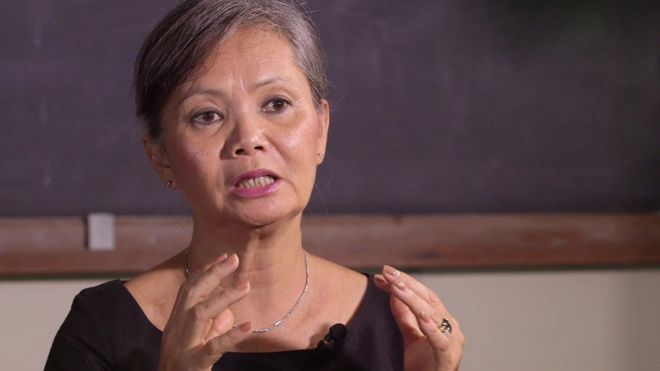
South-East Asia correspondent Jonathan Head in Bangkok - the exact location is being concealed for her safety.
"To flee the country has never been part of my agenda," says Mu Sochua, sitting in a bare room in Bangkok where she is in transit to another, as yet undisclosed, destination.
"It is a choice I thought I would never have to make. It is a very painful choice."
Earlier this week she was warned, she says, by sources close to the government that she would be arrested by the weekend.
Last month her party leader, veteran human rights campaigner Kem Sokha, was taken from his home by 200 police officers and charged with treason. Last week Prime Minister Hun Sen said others would be arrested on the same charge.
"I no longer felt safe. What I was afraid of being captured and being silenced, put in jail, and having my case go through our kangaroo courts for months and months," said Mu Sochua.
"We don't have months to waste. Elections for Cambodia are scheduled for 29 July 2018. So I intend to have my voice heard."
Harassment of opposition figures is nothing new in Cambodia. Ever since the country was guided out of the years of war and revolution in the early 1990s by a massive international operation and given a new democracy, human rights groups have catalogued repeated attacks on political and human rights activists. Some were tried in Cambodia's notoriously corrupt courts, some were physically assaulted.
Cambodia profile
Listen: Cambodia - Country for sale?
Cambodia leader tells critics to pay up, or pack up
The finger of suspicion has nearly always pointed in the direction of Hun Sen - the blunt-speaking strongman who has ruled the country since 1985 - or his cronies. No-one has ever been properly held to account for a series of political killings, the latest Kem Ley, an outspoken critic of the Prime Minister who was shot dead in July last year.
Yet a rough but functioning democratic system with a reasonably free media has survived for the past 25 years with local and national elections every five years.
It leaves enough space for critical views and protests to absorb some of the public anger over corruption, environmental destruction and a yawning wealth gap. That may now be changing.

No comments: