

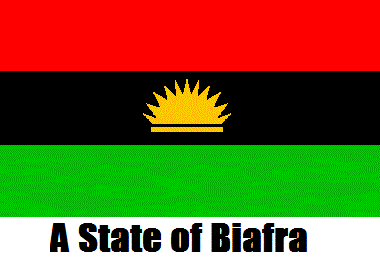
A new nation has been born. Fourteen million people have taken
their destiny into their own hands and embarked on the task of building a
nation free from fear, bitterness and hate.
Their sole aim is to develop their
innate capabilities and rear their children in an atmosphere of peace and
security. They stretch their hands of fellowship to all nations and appeal for
understanding, friendship and co-operation.
We, Biafrans, opted for self-determination after a long period of
heart-searching and after making desperate efforts to save the Federation of
Nigeria from disintegration. More than any other people in the former
Federation, Biafrans contributed their human and material resources to the
cause of national unity. From 1914, when the British amalgamated Northern and
Southern Nigeria, Biafrans began to leave their homeland in large numbers to
settle in several places among the Fulani-Hausa in the North and the Yoruba in
the West. In those areas they opened up new avenues of commerce and industry
and at the same time built new homes and erected places of worship and
institutions of learning. By so doing they came to acquire a real stake in the
progress and well-being of ALL parts of the country. They regarded themselves
as citizens of Nigeria to an extent that no other group in the country ever
did.
Wherever Biafrans sojourned their industry, resourcefulness and
drive marked them out from their neighbours. In the North, particularly, the
distinction was enhanced by religion; for while the majority of the
Fulani-Hausa population were Muslims the Biafrans were and still remain mostly
Christians. In addition, the progress and dynamism of Biafrans contrasted with
the tardiness and conservatism of their neighbours who were generally unable to
achieve the same standards of efficiency and prosperity. The envy and animosity
the Biafrans excited were manifested periodically, such as in the massacre of
Biafrans by Northern Nigerians at Jos in 1945 and at Kano in 1953.
While Biafrans abroad were thrusting ahead and setting the pace
for the economic development of Nigeria, those in Biafra itself were diligently
exploiting the human and material resources of their homeland. Their ready
acceptance of modern ideas and techniques brought them to the forefront of
economic and political activities. Democratic by tradition, they championed
democratic ideals and at the same time advocated the concept of a united
country. They resolutely opposed the reactionary ideas of the Fulani-Hausa
ruling elite which controlled the North and dominated the Federal Government.
They also resisted the vicious and unscrupulous methods by which the
Northerners sought to perpetuate their hold on the political strings of
Nigeria. It was largely this confrontation between the forces of progress,
represented by Biafrans, and those of reaction, represented by the Fulani-Hausa
which culminated in the Nigerian census crisis of 1963-64, the Federal election
crisis of 1964 and the Western Nigeria election crisis of 1965 which brought
the military to power in January 1966.
During the massacre of 29 May 1966, which was the reaction of the
Fulani-Hausa to Unification Decree No. 34 of the Supreme Military Council,
Biafrans were the sole victims and there was no discrimination with regard to
their individual ethnic origin. The massacre of Biafran army officers and men
by their Northern "comrades-in-arms" on 29 July 1966, and of Biafran
civilians later, followed the same pattern: they were killed only because they
were Biafrans.
Those who survived the pogrom fled back to their homeland
disillusioned and embittered. Their investments in other parts of the
Federation had been destroyed and those whom they held dear had been killed or
maimed. The families in Biafra who received them back shared their grief, and
hardly any family in Biafra escaped the loss of a member or the return of a
destitute relative needing relief. The Northern Assailants showed no sign of
remorse. On the contrary they were jubilant over the expulsion of the Biafrans
in their midst. The Biafrans themselves would never think of going back to
expose themselves to the risk of a repeat of their previous harrowing
experience. Thus the pogrom of 1966 resulted in an irreversible movement of
population.
In spite of all they had suffered during earlier massacres and
during the more recent pogrom, the people of Biafra sought no revenge but
strove strenuously to find a peaceful solution which would keep Nigeria
together. The Northerners, on the contrary, rejected every overture, ignored
the implementation of agreements which had been mutually arrived at, and relied
on their military occupation of Lagos and Western Nigeria to humiliate Biafrans
even further.
Two of these agreements stand out clearly. As far back as 9 August
1966 representatives of the Military Governors and Lt.-Col. Gowon agreed in
Lagos that, inter alia "Immediate steps should be taken to post military
personnel to barracks within their respective regions of origin". It was
generally recognised that tension would be reduced and Biafrans would have less
fear of attending meetings elsewhere in Southern Nigeria if this measure was
taken. The implementation of this agreement was pressed on numerous occasions
from August 1966 until the collapse of the Federation, but was totally ignored
by the Northern "conquerors". Again, after long persuasion, the
military rulers of Northern Nigeria agreed to attend a conference at Aburi,
Ghana, in January 1967. Far-reaching decisions aimed at restoring the Federation
to normalcy were taken at this meeting. As is now well-known, the Northern
military rulers at first repudiated the decisions as soon as they returned to
Lagos but, following further persuasion both from within and outside Nigeria,
proceeded to implement only a portion of the Aburi decisions. At the same time
the Federal Government contrary to an Aburi decision stopped paying its staff
serving in Biafra, and withheld the Biafran share of Federal revenues.
The protests of Biafrans against the attitude of the North were
met with threats of military subjugation. The proposal that Nigerian military
lenders should meet in the presence of named African heads of States was
spurned. The stoppage of salaries of Biafrans in the Federal public Service and
Corporation compelled the Government of Biafra to pay these salaries in
addition to bearing the financial burden of rehabilitating other refugees and
displaced persons. Then the Lagos Government continued to withhold the periodic
payments and remittances from Federal funds due to the Government of Biafra,
the Biafran Government was forced to take steps to stop the continued
accumulation of debt by the Lagos Government by promulgating the Revenue
Collection Edict. Thereafter, the Lagos Government mounted a blockade aimed at
the economic strangulation of Biafra.
It is this calculated and systematic persecution of Biafrans in
the former Federation of Nigeria that has driven us to seek justice and
salvation in independence. Molested, taunted, hounded, murdered and finally
driven away from other parts of Nigeria, Biafrans have been compelled to
acknowledge that close association with Fulani-Hausa is fraught with disaster.
We have therefore taken up the challenge to our liberty and dedicated ourselves
to the struggle for our survival.
Some well-meaning observers have expressed doubts as to whether
the Republic of Biafra can survive both economically and politically as an
independent, sovereign state. Firstly, they hint that Biafra had been so tied
to the economy of the rest of Nigeria that if the federal links were severed
Biafrans would suffer a fall in their present standard of living. In the second
place they have tried to emphasize that Biafra consists of a composite group of
people who lack the attributes of a nation. Such views have obviously arisen
from an imperfect understanding of Biafra, past and present.
It is, among other things, in order to enlighten the enquirerand
reassure the waverer that this publication is being issued. In the following
pages the reader will discover the real Biafra, a country which has through the
ages undergone a political as well as an economic transformation resulting in
the emergence of a virile and united nation that is capable of sustaining
itself in the committee of nations.
II. The Country
The country, Biafra, is an almost rhomboid shaped territory which
is demarcated to the west by the lower reaches of the River Niger and its
Delta, to the East by the Obudu plateau and the Highlands of Oban and Ikom, to
the south by the Bight of Biafra and to the North by an administrative boundary
following, approximately, the 7 deg. N. latitude. The total area is over 29,400
square miles. Thus Biafra, almost as big as Gambia and Sierra Leone put
together, is bigger than Togo or Rwanda and Burundi combined, and is four times
the size of the Republic of Israel.
The territory is well-watered throughout the year, lying to a
large extent in the basins of the Niger River, the Cross River, the Kwa River
and the Imo River. Three quarters of these river basins are lowland less than
400 feet above sea-level. The well-known Niger Delta which extends through two
of the twenty provinces of Biafra, occupies about one-fifth of the lowland.
North of the lowland the country rises gradually through open flat land to the
Oban hills and Obudu plateau in the east and the Nsukka and Udi hills in the
west. The Obudu plateau rises to over 6,300 feet and is one of the coolest and
mast delightful parts of West Africa. There are also beautiful uplands in the
provinces of Okigwi, Orlu and Nsukka.
Biafra is wholly located within the tropics, being only a few
degrees north of the equator. But the climate, although humid at some periods
of the year, is on the whole not too hot. Monthly average temperatures range
between 70 deg. F and 90 deg. F, and average rainfall from about 60 inches in
the north to about 140 inches in the Niger Delta. Like the rest of West Africa,
the territory has two main seasons, namely a rainy and a dry season. The former
generally begins towards the end of April but remains mild until the period
June to September when the rains become heavy though intermittent. There is
usually a short break in the rains during the first two weeks of August. The
dry season which, in most parts of Biafra, lasts from November to March is
characterised by relatively light rainfall. A Prominent feature of this season
is the dry, bracing Harmattan wind that blows from the Sahara southwards
between the months of December and February.
The tropical climate of the country favours the growth of
luxuriant vegetation. Mangrove forest covers a depth of between 10 and 40 miles
of the coastal lowlands, including the Niger Delta. Beyond this belt is the
rain forest which extends northwards for approximately 80 miles. In the few
places where the forest is still virgin are to be found many species of giant
and medium-size trees with a thick evergreen canopy of broad leaves which
restrict the penetration of sunlight. Except in the forest reserves, which are
located especially in parts of the Cross River basin, much of the rain forest
has been cleared and is honey-combed with villages, farms and oil-palm groves.
North of the rain forest, as far as the Northern boundary of Biafra, the
vegetation thins out into rich grassland or Guinea Savannah which is
characterised by tall grasses and medium size trees.
III. The People
INTER-GROUP RELATIONSHIP
According to the last census conducted in November 1963 the
population of the Republic of Biafra is 12.4 million, The figure has risen by the
date of this publication to over 14 million following the crisis of 1966 in the
former Federation of Nigeria and Which, as has already been mentioned, forced
Biafrans in other parts of the Federation to take refuge in their home region.
The present population of Biafra, therefore, equals the total number of people
inhibiting the West African states of Togo, Dahomey, Ghana, Liberia, Sierra
Leone and Gambia put together. In the whole of Africa, Biafra is now the fourth
largest in population, exceeded only by Nigeria, the U.A.R. and Ethiopia, and
equaling Congo Kinshasa. However, her population density of about 500 persons
per square mile is the highest in the whole of Africa. The significance of this
factor in terms of economic development arid potentialities is obvious.
A tradition that has become generally accepted divides the
population of Biafra into four main "tribes"; a division which
accounts for ninety-eight per cent of the total population inhabiting the
country, namely, the Ibos, the Ibibio-Efiks, the Ijaws and the Ogojas. But, in
fact this is an over-simplification introduced by people foreign to Biafra.
Until the above classification, the people of the territory did not live or
regard themselves as homogenous "tribes" differing one from another;
rather, they lived in towns and villages each of which regarded itself as
distinct although in many cases linked to its neighbours by a mythical or real
ancestor. Thus the people now known as Ibos thought of themselves as Awka,
Bende, Aro, Ngwa, etc.; the Ibibio-Efiks as Uyo, Itu, etc.; the Ijaw as Okrika,
Ibani, Kalabari, Nembe etc.; and the Ogojas as Ekoi, Akunakuna, Boki, etc.
In other words, the present Ibos, Ibibio-Efiks, Ogojas and Ijaws
did not regard themselves as such until they were so classified by foreigners.
For example, the word "Ibo" was probably derived from
"Heebo" which, according to some European trader of the 19th century,
was the name given by Biafran traders on the coast to the hinterland area where
they traded. Subsequent European traders slightly changed the word to
"Eboe" from which "Ibo" was derived. It should be noted,
also, that the same Biafran traders on the coast differentiated between the
"Ibo" in the hinterland and the "Kwa Ibo", that is, Ibos
living on the Kwa river. The latter are now known as Ibibios. The traders, of
course, were merely using the word "Ibo" as a general term for people
living in the hinterland rather than for a tribe in the modern sense of the
word. The term "Ibo" was applied by all the inhabitants of the
Eastern Delta to those of the Western Delta and never to themselves. It is
interesting to note also that the riverine groups on the banks of the lower
Niger, Onitsha, Osomari, Oguta etc., refer to their hinterland neighbours as
"Igbo", a term which they do not apply to themselves. Thus it would
seem that modern tribal consciousness, represented by the application of the
term Ibo, Ibibio, Ijo or Ogoja in Biafra, was fostered not by the people
themselves but by foreigners who were ignorant of the intricate bonds which
held the country together and who classified Biafrans according to their own
linguistic and other criteria.
These bonds were woven from the earliest times when the territory
was peopled. Archaeological evidence reveals that Biafra has been under
continuous human occupation for at least 3,000 years and, as is now being
discovered, that her people developed an ancient civilisation a thousand years
ago, that is about half a millennium before the emergence of the Kingdom of
Benin. Linguistic data also confirm the antiquity of the main languages spoken
in the area. It seems, therefore, that the main groups of Biafra were
indigenous to the territory and that contact among them has existed since
primeval-times. This does not mean, of course, that the area was not touched,
even in early times, by external influences. Naturally, populations on both
sides of the Biafran borders have had cultural and other exchanges over the
centuries. Thus the Delta city-states of Kalabari, Bonny, Brass, etc., have
traditions which reveal an early Benin influence, while the riverine
city-states of Onitsha and Osomari have some cultural affinities with Benin and
Igala. More recently, of course, the entire area his come under the influence
of Western civilisation. But while these external influences are significant,
what is of paramount importance is the acculturation and inter-dependence which
have taken place among the various indigenous groups within the area, and which
have welded them together over the centuries.
One cause of the acculturation could be ascribed to the periodic
movement of population from one area to another within the territory. Sometimes
the movement was slow, took many years and involved very long distances. In
some cases, however, it was fast and comparatively short. In either case the
consequence was to bring new peoples into new areas and to open opportunities
for cultural interaction and diffusion.
Another cause of the acculturation was the economic nexus which
developed in the territory from very early times. Because the communities were
interdependent economically, trade tended to flow in all directions and the
constant meeting of people from various communities enabled each to learn, and
sometimes to emulate, the customs or borrow the vocabulary of the other. For
example, two of the most important articles of trade, salt and dried fish, were
provided by the Delta communities who then received in exchange some of the
farm products of the hinterland. As might be expected, the constant movement of
traders through contiguous areas further encouraged mutual understanding.
The growth of the oversea trade in slaves intensified commercial
relations within the territory and also fostered the integration of Biafra. The
Delta, from where the slaves were exported, became a melting pot in which the
"Ibos", "Ibibios", and "Ijaws" virtually lost
their separate identities. New families and new ruling houses emerged from the
admixture and modified the existing order. For example, among the Delta communities
Ibo-speaking men rose to the exalted position of paramount ruler. An English
trading captain, H. Crow, who visited the Delta in the late eighteen twenties,
recorded that "the King of New Calabar (modern Kalabari) ..., and Pepple
King of Bonny, were both of Ibo descent". At the same time liberated
slaves who returned to their original homes in the hinterland to trade,
introduced new ideas and practices. When the palm oil trade superseded the
slave trade a further step was taken towards inter-community diffusion. The
nature of the palm oil trade necessitated the establishment of colonies of
people not indigenous to the locality, and their culture influenced and was
influenced by the surrounding population.
It was not only trade that contributed towards the evolution of a
homogenous Biafra in the precolonial era; there was also the contribution of
the prevalent division of labour within the territory. Individual communities
were noted and relied upon for specific skills. This encouraged their movement
from one place to another during which the inter-dependence of all the
communities was enhanced and emphasized. For example, the people of Awka were
famed throughout the centre and north of Biafra as wood-carvers, while the Nri
people supplied the priestly class so essential for the religious welfare of
the surrounding communities. Southwards, there were the blacksmiths, of
Nkwerre, the wood-carvers of Annang, the Item and Ibibio doctors, the warriors
or mercenaries of Ohafia and Abam and the priests of Arochukwu. Thus it came to
be generally accepted that one community supplied the wants of another and the
tradition of mutual reliance and support, now characteristic of Biafrans,
became established.
Mobility over the centuries depended on the intricate system of
road and water communications which linked the whole territory together. Along
these traveled the traders, the craftsmen, the itinerant priests, the
medicinemen and the emissaries of the various communities. The most important
markets in Biafra were held at specific, well-known intervals and were so sited
that traders had to move from one part of Biafra to another.
It is probable that if a strong military power had arisen within
the territory capable of subjugating the city-states and villages, a powerful
nation under one political direction would have emerged before the advent of
British rule as happened in other parts of the African continent. Such a
political authority, however, was not necessary given the Biafran way of life.
As will be seen below, relationships among Biafrans was moderated by
matrilineal connections, and attitude to warfare was mild to the extent that
combatants readily yielded to arbitration by third parties, or by the Long Juju
Oracle of Arochukwu which was recognised as a final court of appeal by
virtually all the inhabitants of Biafra.
One consequence of the process of acculturation was that groups
emerged in the region which, although possessing certain dissimilarities in
language, custom and tradition, yet retained many common links baffling to the
foreigner in search of simple explanations and classifications. Inclined
towards generalisations, the Europeans who penetrated into and later ruled
Africa, found common names for groups of people with the greatest obvious
similarities and labeled they as "tribes", "sub-tribes",
"clans" etc. In place of the ever continuing cultural diffusion a
process was set in motion which not only labeled groups but compartmentalised
and isolated them. Thus groups of people became more self-conscious than they
had ever been and learned to identify themselves with such "tribal"
names as Ibo, Ibibio, Ijaw etc. This tendency grew with the consolidation of
British rule and the introduction of "native" administration which
emphasized the separateness of "tribes".
It could thus be seen that, comparatively, the current tribal
labels are of very recent origin. Nevertheless, as a result of the spread of
Western education, the names have gained wide acceptance. Furthermore, with the
advent of self-government and the emergence of political parties, the skilful
and often unscrupulous exploitation of the emotions associated with these
labels has served as a useful tactic for securing electoral victories. The result
has been to deepen the impression of distinctiveness already created by the
universal acceptance of the labels.
However, while British rule and its immediate aftermath on the one
hand, has tended to emphasize the "tribe", Western technology, on the
other, has introduced new links which have contributed towards the political,
social and economic integration of Biafra. The use of modern and fast means of
transport, the growth of new cosmopolitan towns and the spread of Western
education have had the effect of further blurring the differences between and
enhancing the interdependence of the various communities. Differences in
language have been largely overcome by the use of English, and any one with a
smattering of that language can easily move from one corner of the nation to
another without fear of being unable to communicate with the people he would
meet. Furthermore, since Biafra never came under the influence of Islam the
spread of Christianity has not caused such complications in religious belief as
are often found in places where two vigorous foreign religions and cultures are
superimposed on the indigenous religion. Finally, it should be pointed out that
for nearly three-quarters of a century Biafra has been ruled as a single
political unit and the vast majority of the population have grown accustomed to
the fact of their political uniqueness as Biafrans.
POLITICAL AND SOCIAL SYSTEM
The extent of acculturation in Biafra is clearly demonstrated by
the similarity in the political and social systems of all groups. Although the
account which follows largely refers to the Period preceding colonial rule, it
must be borne in mind that much of the political and social system discussed is
still in vogue.
Each of the groups possessed central administrative and judicial
institutions, and power as well as authority was based not on birth but on
wealth, status and age of the individual or individuals wielding them. Ultimate
pourer, however, did not reside in the central authority, which consisted
essentially of a federation of politically equivalent segments, but in the
segments themselves.
Usually the government of the community was entrusted to a Council
of Elders who were heads of the component segments known either as compound,
hamlet or ward. The council was presided over by a head who must be acceptable
to all and who was, in a political sense, a first among equals. The Council of
Elders was not really a legislative body but an informal body which met as the
occasion arose. Its primary function was to take decisions on weighty
matters affecting the whole community,
such as the declaration of war and peace, the settlement of serious internal
disputes which otherwise might wreck the solidarity of the community, and the
regulation and performance of rituals aimed at safeguarding the welfare of
members of the group.
The day-to-day affairs of the segment rested with the Elder
(variously called Okpara, Etubom, Ete Ekpuk etc.). He wields political,
judicial and religious authority, arbitrated in internal disputes and
represented the group in its external relations with others. His authority was
generally accorded chiefly because he was recognised as the intermediary
between the group and its ancestors,
Throughout Biafra there has always been an identical attitude to
law and custom. Both were inextricably bound together and were believed to have
been handed down to the people's ancestors by the gods. Thus anyone who
violated those laws not only incurred the displeasure of the living but also
the anger of the ancestors as well as of the gods. This attitude towards law
helped in minimising anti-social behaviour. Sometimes it was necessary to make
a new law, and for that the consent of the entire community had to be sought; a
practice which was relatively easy on account of the small size of each group.
This traditional process of general participation in the act of law-making
provided, for the young and old alike, vital education in the principles of the
existing social order. Subsequently, the law was ratified by the Elders and
given divine sanction by sacrifice and by invoking the approval of the
ancestors. It is this element of popular consent and direct participation in
the enactment of laws which attracted the attention of foreign visitors to
Biafra and led them to conclude rightly that Biafrans were ultra-democratic,
highly individualistic and disliked or suspected any form of external
government and authority.
In the sphere of social relations, Biafrans had a common attitude
to marriage. Marriage was not regarded in any part of the country as an affair
between two individuals, a man and a woman, but between the whole family of the
man and that of his prospective spouse. Betrothed girls in most parts of the
territory usually went into a period of seclusion sometimes known as the
"fattening" period. Custom encouraged the man to look for a bride
outside his lineage (exogamy) not only because this increased the population of
the lineage but because it created an external alliance, sealed in blood relationship,
which widened the contacts of relatives on both sides. By this means a member
of a, lineage became connected with the lineage of his of his mother or wife or
sisters, and vice versa. He could thus traverse in peace vast distances merely
by passing through areas inhabited by his in-laws. If he was a trader the
advantage of this arrangement was obvious and in this sense it could by said
for Biafrans that trade followed the wife. The system of marriage also had
political implications because, although in the pre-colonial era them was no
single political authority recognised throughout Biafra, the ties of marriage
ensured relative peace and a sense of common belonging.
There were three other social institutions prevalent in Biafra
which demonstrated the extent of her cultural homogeneity. Firstly, there was
the institution known as the "Age-set" or "Age-grade".
Males born in the same year or within a specified number of years were grouped
together to form one ago-set. These sets were organised on village bases but
each unit could, and often did, maintain close ties with an identical unit in
neighbouring villages. The status of the age-set in the community increased
with ago. Often when the members attained the age of between 12 and 15 it was
formally recognised, took a name and appointed a leader. Age-sets rendered such
services to the community as the clearing of paths, cutting of forests, and the
defence of the village. They imposed self-discipline on their members and could
punish them for any laxity in behaviour. In many cases women were also
organised in age-sets and these might contribute to a common fund for mutual
assistance and usually acted as pressure groups within the community.
The second institution was the title society. Membership of these
societies was secured not by birth but through age and individual merit as
represented by the ability to make the appropriate payments in cash and in
kind. Usually these societies were open only to the free born, but among the
Delta communities slaves who were able to afford the initiation expenses could
readily become members. It was common for such societies to be graded in an
ascending order of seniority which also conferred increasing privileges and
status. Membership could only be gained according to the stipulated order and
after the requisite rites had been performed.
Lastly, there were the secret societies, a large number of which
still exist. In many cases title-holders were associated with specific secret
societies, and the two institutions thus tended to coincide. In other cases,
however, the two were separate, with secret societies constituting a larger
group to which every full member of the community could be admitted. One of the
most common of these societies was the Ekpe (also known as Egbo, Akang, Ekpo
etc.) which also corresponded to the Owuogbo of the Delta in its functions.
These secret societies were used to uphold the legal decisions of the Council
of Elders or of the community as a whole, they also ensured conformity in
certain rituals and in social behaviour and undertook certain public works for
the community. Membership of some secret societies and knowledge of their signs
(for example Okonko) served as a passport for the initiate while travelling in
distant places where a lodge of the society existed. This, in a way, helped to
foster social integration within tine country.
In the religious sphere, there has always been an element of
homogeneity in Biafra. As already stated, Islam never touched even the borders
of the territory. The result has been that until the advent of Christianity in
the nineteenth century all Biafrans followed the religion of their ancestors.
There existed a universal belief in a Supreme Deity (variously celled Chuku,
Chineke, Abasi etc.) which resided above and was the source of creation, life
and fertility. Apart from the Supreme Deity, it was also believed that there
were other lesser gods of thunder, sun, wood etc., as well as spirits which
were divided into the good and the evil depending on their supposed attitude
towards the individual or the community as a whole. The cult of the
"Earth" spirit was one of the most important in Biafra. This deity
was regarded as the mistress of the underworld and the cult of the ancestors was
closely associated with it. Some of the more serious crimes such as murder,
adultery, poisoning and stealing farm products were regarded as offences
committed against the Earth deity. Laws were enacted and oaths sworn in her
name so that reverence for the Earth Spirit became one of the integrative
forces for most communities.
With the introduction and spread of Christianity most of the
traditional deities have been abandoned and Christian beliefs have supervened.
The change has also advanced the integrative effects of indigenous religion by
providing a basically uniform system of beliefs which pervades social and
political thought and practice throughout Biafra.
IV. Economic Resources
The greatest economic asset of Biafra is her human resources. The
people have long been famed for their industry, initiative, self-reliance and
an almost insatiable thirst for learning. Her relatively large and dense
population provides a ready and easily accessible market for agricultural and
industrial products. There is therefore a genuine incentive for an economic
revolution and already this is beginning to take place.
The government and people of the country realised early the
importance of education for a developing country and now there is an abundance
of skilled men and women in most aspects of human endeavour. The key role which
Biafrans played in keeping the wheel of commerce and industry revolving
throughout Nigeria vas cloudy demonstrated in 1966. When the survivors of the
pogrom fled to Biafra the Nigerian economy, especially in the North, almost
ground to a halt. Biafra is making even greater efforts to educate her people
and to provide them with the knowledge and skills for survival in this age of
technology.
At the moment Biafra has a primary school population of about
1,250,000 which is almost equal to that of what now remains of Nigeria. Her
secondary grammar school population of 65,000 accommodated in 283 separate
institutions bears the same proportion to Nigeria. In 1967 there were also 33
secondary commercial schools with an enrolment of 5,674 and the number enrolled
in secondary technical schools exceeded 5,000. In the field of higher education
Biafra has a university at Nsukka (a second campus of the University is at
Enugu) with an undergraduate enrolment of nearly 3,000. This university now has
nine Faculties including such crucial ones as agriculture, engineering and
medicine. A second university for Biafra (The University of Science and
Technology) will open at Port Harcourt in October 1967. At Enugu, the capital
of Biafra, there is also an Institute of Administration for training high-level
administrative and managerial man-power, a University Teaching Hospital for
training doctors and ancillary medical staff, and a Law School far the
professional training of jurists. Biafrans graduating in various disciplines
and vocations from institutions
of higher learning at home and abroad exceed 1,000 annually. There is no
country in Black Africa that excels Biafra in the educational facilities
provided for its people.
One of the well-known characteristics of Biafrans, namely
self-reliance, has been of immense value in the development of the country.
Community developments, for instance, started in Biafra with village
communities raising funds, and providing voluntary labour to construct roads to
link their villages with major towns and markets. By the late forties,
community development efforts had extended to the construction of hospitals,
maternity homes, dispensaries and village schools. Many communities were stimulated
to greater efforts by the work of Mr. E. R. Chadwick, a British District
Officer at Udi. Recognising the self-help characteristic of the Biafrans he
organised the people of his district for general community development projects
including a 5-mile road, a village school, a maternity home and a co-operative
shop, activities which he recorded in a film entitled "Day-Break in
Udi". Church organisations, village and town improvement unions,
age-grades and various other societies all have taken an active part in
providing for the communities in Biafra such social services as water supply,
postal agencies, bridges, town halls and market places. And when, in 1963, the
Government of Biafra directed that emphasis should be shifted from the projects
on social services to those that stimulate economic growth, many communities
responded and undertook various agricultural and industries projects - all with
minimum Government assistance. Some of the projects which, have recently been
completed by community effort are listed below:
Some of the Community Development Projects Completed in Biafra
Social Service Projects
Bridges (feet) 12,561
Roads (miles) 4,714
Co-operative Shops (No.) 13
Postal Agencies (No.) 214
Maternity Homes (No.) 628
Leper Segregation centres (No.) 36
Hospitals and Rural Health centres (No.) 89
Dispensaries (No.) 350
Community Schools and Domestic Science centres (No.) 275
Adult Education (No.) 1,216
Libraries (No.) 60
Market Development (No.) 166
Water Supply (No.) 302
Embankments (No.) 211
Village Halls (No.) 563
Economic Development Projects
Rubber Plantations (No.) 31
Oil Palm Plantations (No.) 133
Cocoa Plantations (No.) 8
Cashew Plantations (No.) 2
Food Crops Farm Projects (No.) 23
Mixed Farming Projects (No.) 11
Fish Ponds Projects (No.) 5
Poultry and Livestock Farms (No.) 75
Weaving (Textile) industry (No.) 65
Wood Carving industry (No.) 7
Brushmaking industry (No.) 1
Blacksmithing industry (No.) 1
Raffia Products (hats, bags, cane chairs etc.) industry (No.) 5
Food processing (cassava grating, corn mill etc.) industry (No.) 4
Biafra is not only rich in human resources but is also blessed
with enormous material resources some of which are only recently being realised
and exploited. In the pre-colonial era, of course, the country was famous for
its palm oil and palm kernel and for long under British rule the revenue
derived from these were used in balancing the budget of the whole of Nigeria.
Indeed the whole rationale for the amalgamation of Northern and Southern
Nigeria in 1914 was to enable the colonial power to use the revenue derived
from the South, and especially from Biafra, to offset the deficit incurred in
the budget of Northern Nigeria.
In recent years Biafra has improved its production of palm
produce. It is generally known that Nigeria was one of the world's most
important exporter of palm produce, supplying 50 per cent of the World's palm
kernel and over 30 per cent of its palm oil. What is perhaps not so well-known
is that Biafra produced over 90 per cent of the Nigerian palm kernel and nearly
50 per cent of the palm oil. During the current Six-Year Development Plan which
expires in 1968 Biafra has spent almost £4 million in the establishment of
plantations and the rehabilitation of old palm-trees. Thus the future of this
vital source of revenue is assured for Biafra.
However, the Government of the territory has not failed to
appreciate the danger of a single-crop economy. Thus it has for a long time
embarked on the extensive cultivation of such cash crops as cocoa, rubber and
copra. As regards cocoa, it is anticipated that production in Biafra will
amount to about 10,000 tons per annum, by 1968. Large plantations of rubber
have been established in some parts of the country. One of them established by
the Dunlop Rubber Company is valued at about £1,000,000. Exports of rubber from
Biafra now is almost 60,000 tons per annum and this figure is likely to
increase greatly when the plantation scheme of the country begins to mature.
Biafra also produced over 60 per cent of the copra exported from Nigeria and
further extension of the plantations have been made. Other agricultural
products which are being exploited on an increasing scale are raffia, piassava,
jute, castor. soya beans, groundnuts, benniseed and sugar cane.
At the same time, Biafra is almost self-sufficient in the
production of food crops. This was demonstrated when, as a result of the recent
crisis, the flow of foodstuffs into and out of Biafra ceased. It was discovered
that the cost of several food items dropped considerably resulting in a
remarkable reduction in the cost of living, in spite of the extra-ordinary rise
in the population. Common food crops produced in the country include yams,
tomatoes, bananas, pawpaws, cassava, rice, beans, plantains, pineapples,
onions, peppers, oranges, avocado pears, etc. Protein, especially meat, was
supplied in the post largely from external sources but recent events have shown
that even here Biafra could easily be self-sufficient. The cattle ranch at
Obudu, a place 5,000 feet above sea level and free from tse-tse fly, now
produces a substantial quantity of the country's meat supply and more ranches
are being established. There is also a large and growing stock of goats, sheep
and pigs. Poultry-keeping has recently become a thriving business in the
country and Biafra is at present virtually self-sufficient as regards the
supply of eggs and chicken.
Owing to its geographical position, Biafra is rich in timber, most
of which is yet to be exploited. Approximately 9 per cent of the total area of
the country has been designated forest reserves and there is a vast acreage of
forest plantations. Biafra now exports nearly 3 million cubic foot of logs end
about 35,000 feet of sewn timber annually.
The country does not depend an its agricultural and forest
resources alone; there is also an abundance of mineral deposits which is
contributing enormously to the wealth of Biafra. Limestone of a high grade,
suitable for the manufacture of cement, is found in many parts of the
territory. A substantial iron ore deposit, with a metal content of about 42 per
cent after beneficiation, has been discovered near Enugu. Around Abakaliki, in
the north, there are large deposits of lead and zinc ore; as well as a small
quantity of silver. Potential annual production rates have been estimated at
13,150 tons lead concentrates and 8,150 tons zinc. There is also an abundance
of clay deposits all over the country suitable far ceramic and other industrial
purposes. Large quantities of sandstone and glass sands exist on the outskirts
of Enugu as well as at Afam, Port Harcourt and elsewhere. A mineral which has
played a great part in the economic development of Nigeria is coal. It has been
mined in Biafra since 1914 and is the only source of this form of fuel in West
Africa. In 1950 the total output was well over 900,000 tons but since then the
market for coal has been shrinking, mainly because an increasing number of
countries are now using diesel, fuel oil and natural gas instead of coal as a
source of energy.
The discovery nearly ten years ago that Biafra possessed oil and
natural gas in commercial quantities was a milestone in the economic
development of the country. The exploitation of these minerals has made
astonishing progress. In 1958 crude oil production was 229,458 net tons but
five years later it had risen to 3,694,981 net tons. Current production stands
at over 7 million net tons annually. More oil deposits are still being
discovered in the country and production is yet to begin from a large number of
oil-bearing wells. Similarly, vast quantities of natural gas have barn
discovered in a number of areas within the country. It has been estimated that
production from one area alone could easily exceed 50 million cubic feet a day
if fully exploited.
The exploitation of mineral resources in Biafra has naturally led
to the establishment of a number of industries and the projection of several
others. Two cement factories at Nkalagu and Calabar, with a total potential
output of about 6 million tons annually, use local limestone. It is anticipated
that an Iron and Steel Industry will soon be started which will be based on the
iron and coal deposits of the country; already a small steel rolling mill is in
operation near Enugu. The clay deposits of the country serve one ceramic and
two pottery industries. A glass factory has been set up at Port Harcourt to
exploit local deposits of glass sand. There is now in operation an oil refinery
which 1s fed by local crude oil, and the establishment of a full-scale
petro-chemical industry is under active consideration.
The list of industrial projects under operation or planned is by
no means exhausted. In the colonial era factories had been established in
Biafra to manufacture cigarettes, soap, furniture, metal doors and windows,
drinks (soft and alcoholic) and aluminium roofing sheets. Since 1960 those
industries have increased their output and new ones have been started. Late in
September 1962, the £3 million Michelin Plant in Port Harcourt produced the
first pneumatic motor tyre to be manufactured in West Africa. There are also
two textile mills in the country valued at nearly £8 million. Two large
aluminium companies supply the country's needs of corrugated iron sheets,
semi-fabricated aluminium sheets and cooking utensils. There is a factory for the
manufacture of asbestos, cement sheeting products and pressure pipes. A modern
shoe industry at Owerri manufactures foot-wear of all types. There are also
factories for the manufacture of industrial gases, enamelware, flour, plywood,
stationery, razor blades, matches, cosmetics, pharmaceuticals, paints,
gramophone records, etc.
>From the foregoing can be seen that few countries in Africa
possess economic resources, human and material, comparable to Biafra. The
resulting impact of the judicious exploitation of these resources on the life
of the people has been remarkable. It is noticeable, for instance, in the rapid
growth of the urban population over the past few yours; the population of each
of the principal towns (Enugu, Onitsha, and Port Harcourt) already exceeds
400,000. All the principal towns are linked by about 2,500 miles of tarred,
all-season roads, a record in Africa. On the whole, there are over 17,500 miles
of road in Biafra, probably the densest road net-work in Africa.
A railway line, 192 miles long, runs from Port Harcourt through
the heart of the country to Northern Nigeria.. The country is also served by
three air ports at Calabar, Enugu and Port Harcourt. Enugu airport is at the
moment being lengthened to accommodate jet planes and a new International
airport is proposed for Part Harcourt. The principal port of Biafra at Port
Harcourt is one of the largest in West Africa; the port now has eight main
berths with a depth of 35 feet, transit sheds and a warehouse capable of taking
15,000 tons export produce. Further expansion of the port and its facilities is
in progress with a loan of £3.5 million from the World Bank. There are two
other smaller ports at Calabar and Degema while Bonny has recently been
developed as an oil terminal for the export of crude oil.
Biafrans, engaged in farming, fishing or cottage industries in
their villages, have also benefited from the economic growth of the country.
They are, in many cases, now served by pipe-borne water and good roads, and a
rural electrification project has already been launched to provide them with
light and power. Their children have local primary schools within easy reach,
and a secondary school is usually not far away. Hospitals or clinics are also
close at hand for the sick; and so are maternity centres.
V. Conclusion
Enough, it is hoped, has been said above to introduce the reader
to Biafra and its people. It is a country inhabited from very early times by
much the same people as live there today. The people evolved a political system
which for hundreds of years allowed each of the small component groups to
manage its own affairs but at the same time to regain certain cultural and
economic links that bound the country into a relatively peaceful and
homogeneous unit. With the advent of Europeans and the imposition of colonial
rule those links were ignored in the search for labels so that Biafrans seen
began to be regarded is members of four main "tribes" called
"Ibo", "Ibibio-Efik", "Ogoja", and
"Ijo". Subsequently, the formation of political parties and the
exploitation of these labels by unscrupulous politicians led to popularisation
of the tribal label. But, on the whole, something of the old spirit of common
identity remained and was reinforced by the fact that the whole country was
administered throughout the period of colonial rule and after as single
political unit.
Earlier, the creation of an artificial geographical unit called
Nigeria by the colonial power induced Biafrans to settle in large numbers
outside their home. The pogrom planned against them by the Fulani-Hausa of the
North in 1966 has forced the survivors to seek refuge in their original
homeland. Consequently, an irreversible movement of population has taken place
which has revived the spirit of nationalism in Biafra and raised it higher than
ever before. There is everywhere a feeling of common purpose and common destiny
comparable to the anti-colonial movement of the past. Biafra has now resolutely
joined in the committee of nations as a sovereign country which Biafrans see as
their only salvation if they are to survive as a people. Having lost ever
30,000 of their nationals and seen the dispossessed survivors hounded out of
the rest of Nigeria they have been left with no alternative but either to
succumb to the domination of the Fulani-Hausa or to stand on their own. They
intensely feel that the path of survival and the path of honour lie in the
latter alternative.
Biafrans have all the attributes of a nation. With a population of
over 14 million living in contiguous
and compact territory, they have an undisputed homeland of their own. They
possess a well-trained man-power reserve second to none in Black Africa. Their
country is rich in agricultural and mineral resources which are capable of
sustaining them and enabling there to stand on their own. They already have
well-developed industries producing a wide range of manufactures, and many more
are either under construction or at the planning stage. They are capable of
defending the integrity of their country and playing an effective role in the
counsels of Africa and the world. Above all they possess an abundance of energy
and an indomitable will to succeed.
LONG LIVE THE REPUBLIC OF BIAFRA


No comments: